André Goezu and works at the Gulbenkian Museum
Contents
André Goezu (1939) was born in a Jewish family in Antwerp, at the brink of the second World War. He escaped the fate of so many other Jews (among them his father) by living hidden with a host family in the Flemish countryside. Goezu has stated that it was during these years he started to draw, and the particular symbolic world he will later cultivate in his art appears to be rooted in these dark years of his childhood. An example would be the recurring motive of the tree, with its connotations of embeddedness and protection.
After studying at the Fine Arts Academy of his hometown he received a scholarship to go to Paris, where he later settled permanently. Due to the upheavals of 1968 Goezu was unable to attend the Academy of Paris; instead he started to explore engraving techniques in the many ateliers existing in the city. Ever since he has pursued a path which gravitates around engraving but also includes painting, drawing and illustration. Especially in the latter Goezu cultivates a particular relationship with literature, through illustrations of French and Belgian classics (Arthur Rimbaud, Emile Verhaeren), collaborations with contemporary writers and artist editions. Goezu was one of the many artists brought to Portugal by the Sociedade Cooperativa de Gravadores Portugueses [Cooperative Society of Portuguese Engravers], to which his presence in the museum’s collection is due. The Portuguese art historian José Augusto-França defined this relatively unknown artist in a rare reference as a “painter of melancholically happy images, made of memories, images which are records of subtly fixed moments, using a range of references which the artist himself confesses being ‘made of some elements, personal symbols’, horses, trees, marching bodies, faces.” (Colóquio/Artes, n. 55, December 1982, p. 76, my translation)
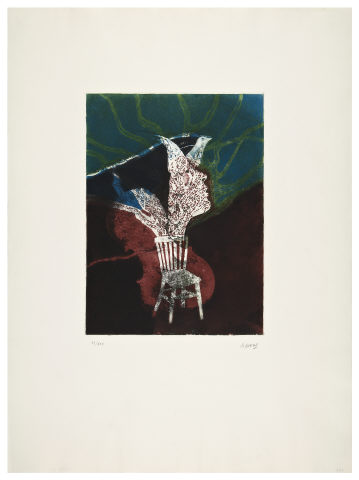
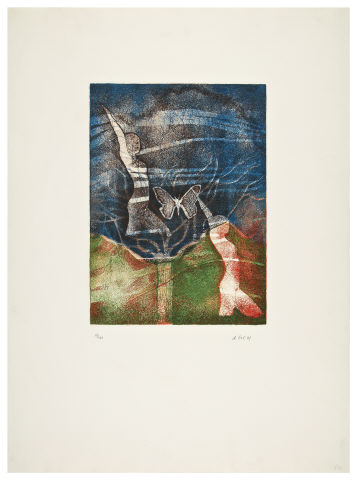
The two untitled works by André Goezu in the Gulbenkian collection are part of a set of 585 engravings acquired in 1988 from the Cooperative Society of Portuguese Engravers, commonly called ‘Gravura’. The society was founded in 1956 and supported by the Gulbenkian Foundation from 1959 on. For several decades it was one of the main promoters of the renovation and recovery of the art of engraving in Portugal. Seeking to promote Portuguese engraving internationally the society established connections and exchanges with international artists and printmaking organizations, bringing a large number of foreign artists to attend the society’s courses and workshops. The Gulbenkian Foundation funded many of these artists’ residences through grants.
André Goezu was most likely one of these artists, creating the engravings from the Gulbenkian collection in November 1977. This was a particularly favourable moment for Portuguese printmaking, as the society’s twenty years of existence were celebrated with a large number of exhibitions realized all over the country in 1976 and 1977.
The artist himself mentions that he came into contact with the Gulbenkian Foundation through his friend José de Guimarães, at that time an active member of the ‘Gravura’ society. Goezu had known Guimarães during the 1960s, first in Antwerp and later on in Paris, where Goezu went to live at the end of the decade.
Regarding these works, executed in aqua-tint on leather, the artist informed they have the titles Chant profond [Profound song] and Floraison [Flowering], describing them as follows:
[Chant profond:] An empty chair remembers the beloved who left. But the sound of her voice, similar to a violin, and the memory of her skin, soft like the plumage of a bird, remain.
[Floraison:] Nature flowered again; the tree comes back to life, the caterpillar becomes a butterfly and the girl becomes a woman.
- Note
- These are slightly modified versions of the texts published at the site of the Gulbenkian Museum (here, here and here). The texts are based on correspondence between the artist and the Modern Art Centre in September 2009; regarding the activities of the Cooperative Society of Portuguese Engravers, see Inês Vieira Gomes, “One look at the Modern Art Centre’s engraving collection,” in 1 / 150. Engraving and multiplying (exhibition catalogue, Almada: Casa da Cerca, 2009, p. 33–36).