Um monumento régio para Belém do Pará: O projecto e a polêmica
Trabalho antigo dos tempos universitários, que arquivo aqui por propor uma leitura que possa interessar ao ocasional estudioso do tema.
Imagem e corpo da Rainha Santa: Uma leitura iconográfica relacional do túmulo de D. Isabel
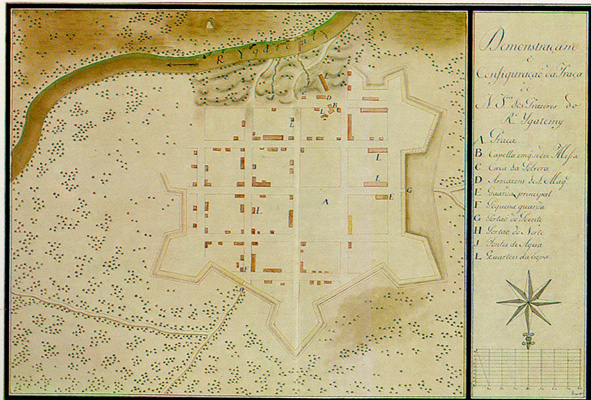
A Fortaleza da N.S.ª dos Prazeres
Uma abordagem a partir d’O Engenheiro Português de Manuel de Azevedo Fortes

Trabalho dos tempos universitários sobre a Fortaleza de N.S.ª dos Prazeres, no Brazil, também chamada de Iguatemi, nome do rio junto do qual foi erguida. A fortaleza é analisada a partir do influente tratado O Engenheiro Português, composto por dois grossos tomos que abrangem todas as áreas ligadas à fortificação e pensado para acompanhar o ensino administrado nas Aulas de Fortificação em Lisboa.
Monumentalidade e espaço público em Lourenço Marques nas décadas de 1930 e 1940: dois casos de estudo
Abstract: Lourenço Marques, actual Maputo (Mozambique), is subjected to a series of aesthetic interventions in its public space during the 1930s e 1940s. These seek to “monumentalize” and “portugalize” the city, responding to its recently acquired status as capital of the Colony. Two important monuments appear as especially important and exemplary: the Padrão de Guerra, a first war memorial (1935), and the monument to the hero of the “pacification campaigns” of the 1890s, Mouzinho de Albuquerque (1940). Around these monuments, a large number of commemorative and celebrative practices is developed. Such practices posit the monument as a “national allegory” and reproduce, in the context of a modern city, auratic and cult values. As such, they add an important dimension to the monument’s role in the authoritarian reformulation of the city’s public space as an “imperial” space, as well as in the putative hegemonization of the representations of the community imagined as a “Nation.” They allow, therefore, to approach the political-ideological use and utility of the monument within the organization of public space.